
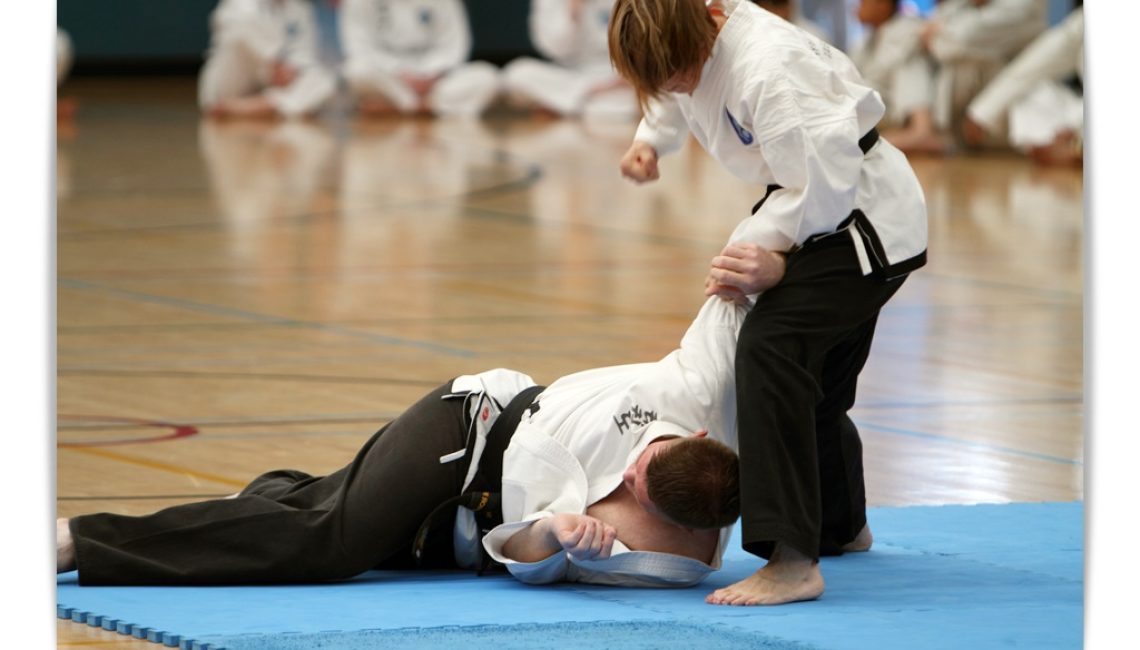
In martial arts, leverage is seen in handling weapons and the human body. In empty-handed fighting, the human body and its parts are used as levers to gain maximum effect with minimum effort. Let us briefly examine leverage and then understand how it is used in martial arts.
Lever and Leverage
Leverage is produced by a lever. A lever is a simple machine. Simple machines are like a lever, a wedge, a screw, a wheel & axle, a pully, and an incline plane. Almost any machine includes one or more of these simple machines.
Simple machines
—A lever is a rigid structure like a beam that freely rotates or moves on a pivot. It helps to move heavy objects with ease.
—A wedge is usually a pyramidal or a triangular structure. It is inserted between two surfaces and is normally used to hold back the surfaces for splitting, cutting, tightening, or for scraping.
—A screw is a cylinder with a spiraling groove having a solid top at one end, and a pointed tip at the other end. It is used to hold things together.
—A wheel & axle is a combination of a wheel and an axle. A wheel is one of the greatest inventions in human history. A wheel needs an axle, which is a small cylinder. Together, they function as a wheel & axle.
—A pulley is a wheel on whose rim there is a groove wherein a rope is placed. A pulley lifts or lowers objects of different weights with relative ease.
—An incline plane is a triangular shaped slope with an even surface. It helps to move objects to higher or lower heights, more easily.
Learn Bright video “Simple Machines for Kids | Learn all about the 6 simple machines!”:
Lever and Classes of lever
A lever is a rigid body capable of rotating on a point (fulcrum), with an input force (effort) and an output force (load/resistance) positioned anywhere on it. Depending upon the relative positions of the fulcrum, load, and effort, there can be three classes of levers, as follows:
—1st class lever. Here, the fulcrum is in the middle with effort and load on either side of it.
—2nd class lever. Here, the load is in the middle with effort and fulcrum on either side of it.
—3rd class lever. Here, the effort is in the middle with load and fulcrum on either side of it.
MooMooMath and Science video “Simple Machines:Levers” :
Next Generation Science video “Types of Levers”:
If more than one lever, or more than one class of lever, are combined, then it creates a compound lever. A compound lever comprises several levers acting in series, where the load/resistance from one lever in a system of levers acts as effort for the next, and thus the applied force is transferred from one lever to the next. Examples of compound levers include nail clippers, piano keys, etc.
Jared Owen video “How does a Grand Piano work? – Part 1”:
Leverage
A lever produces leverage. Leverage is also known as mechanical advantage. Mechanical advantage signifies amplification of effort by using a lever pivoting on a fulcrum to move a load. The level of leverage or mechanical advantage achieved, depends on the position of the fulcrum with respect to the load and effort.
—The length of the lever lying between the fulcrum and the effort, is known as the effort arm.
—The length of the lever lying between the fulcrum and the load, is known as the load arm.
—When the length of the effort arm is longer than the length of the load arm, then the lever produces a mechanical advantage.
—When the length of the effort arm is shorter than the length of the load arm, then the lever produces a mechanical disadvantage.
Mr Reilly video “mechanical advantage and disadvantage”:
MooMooMath and Science video “Mechanical Advantage Force and Lever”:
cg-physics-global video “Explanation of the ‘lever’ (mechanical advantage)”:
TED-Ed video “The mighty mathematics of the lever – Andy Peterson and Zack Patterson”:
A practical example of leverage is seen when cranes load and unload containers at docks. Another example is tearing a wooden log with inserted wedges and application of metal rods.
jeeves2781 video “Container Ship Loading and Unloading”:
@Woodupthehill video “The power of leverage! #leverage #physics #woodupthehill #upthehillwoodproducts”:
Lever in the human body
A brief overview of the human body might be helpful to understand how the human body uses leverage.
National Geographic video “Human Body 101 | National Geographic”:
In the human body, a bone acts as a lever arm, a joint acts as a fulcrum, the muscles act as effort, and the bone, overlying tissues, and whatever needs to be moved by the bony lever acts as the load.
Visible Body video “Biomechanics and Levers in the Body”:
Leverage in martial arts
Martial arts use leverage in innumerable ways. For example, in Taekwondo and Karate, a shout is used while executing techniques. Shouting or yelling in martial arts provides a leverage, as the effort required to shout is less but the power that it produces, is more.
Karate Dojo waKu video “I Investigated If The “Karate Shout” Is Really Necessary…|Kiai 気合”:
Leverage in martial arts is useful while fighting with weapons or without weapons.
Leverage with weapons
Different kinds of weapons use different kinds of levers and thus, have different leverages.
@robinswords video “Two Handed Leverage”:
@robinswords video “More on Variable Leverage in Polearms”:
@tenicorusa video “Leverage on the Gun”:
Leverage without weapons
Fighting without weapons signifies fighting empty-handed and using the human body as a weapon. Leverage can be used in punching, kicking, blocking, and grappling in various ways. All offensive and defensive martial movements are executed with the entire body; however some body parts play a major role in some movements. For example, although leverage is performed by the entire body, but a major body part in punching are the arms.
Martial Spirit: Martial Arts & Fitness video “Boxing Study: Leverage & Rotation”:
In kicks the legs are used primarily to attain leverage.
Martial Arts Industry Association video “Leverage Round Kick – Anthony Graf”:
Blocks may be executed with arms or legs for leverage.
Kudo Ryu Bu-Jutsu video “LEVERAGE BLOCK DEFENCE VS. HIGH JAB PUNCH | From Matching Leads Position”:
@MuayThaiFusion video “Mastering Defense: Front Leg Block in Muay Thai Sparring”:
Grappling relies heavily on leverage, and it uses multiple body parts.
RebelFire MMA video “Human Weapon – MMA – Armbar”:
Techniques that use leverage
Leverage is mechanical advantage that is used to maximize force with minimum strength. All martial arts incorporate leverage in their techniques, and further, each technique has many nuances and several variations. However, some techniques where leverage is most prominently seen, across all martial arts, are as given below.
—joint locks and submissions
—throws and takedowns
—chokes and strangleholds
—sweeps and off-balancing
These techniques use either one’s own body parts or the opponent’s body parts as a lever to obtain leverage.
Joint locks and submissions
Joint locks and submissions apply force in a direction that exceeds the joint’s natural range of motion. A lever is created within the limb of the opponent, so that even a small force can cause significant damage or control.
Keenan Cornelius video “The 7 Deadly Wrist Locks”:
Kevin Goat Self Defense video “Counter Any Wrist Lock”:
@KaliStixSolo video “Kali Stick Grappling series – Part 8 | Arm Crank – Arm Bar | Leverage – Filipino Martial Arts”:
Howcast video “How to Do a Straight Ankle Lock | MMA Fighting”:
Howcast video “How to Do a Knee Bar | Leg Locks”:
JoshRichBJJ video “Every Jiu Jitsu Submission Explained in 8 Minutes”:
Throws and takedowns
Throws and takedowns utilize leverage in such a manner that the size of the person becomes irrelevant. In throws and takedowns, one’s own body is used as a lever to disrupt the opponent’s balance.
Shintaro Nakano video “Top 25 Must-See Judo Throws | Technique & Power with Shintaro Nakano”:
Silat Fan TV video “Silat Takedown Highlights | Compilation”:
Sonny Brown video “Lyoto Machida – Karate Throws, Trips, Sweeps & Takedowns In MMA”:
UFC video “All 54 of Merab Dvalishvili’s Takedowns”:
Chokes and strangleholds
Leverage is prominently seen in all types of chokes and strangleholds. Here both one’s own body parts and the opponent’s, are used to act as a lever.
UFC video “Best D’arce Chokes in UFC History”:
UFC video “Standing Rear Naked Choke Finishes in UFC History”:
UFC video “Biggest Triangle Choke Finishes in UFC History”:
Sweeps and off-balancing
Sweeps use leverage to shift the opponent’s center of gravity from their base of support, which results in the opponent losing balance. This may be achieved either by pushing or pulling. Once balance is lost and the opponent falls to the ground, then the opponent becomes vulnerable to ground-fighting techniques.
Heikki M video “(Muay Thai) Sweeps, Trips & Throws”:
@ufc video “a RARE Scissor Sweep!!!! 🚨 #ufc301”:
Cobrinha Brazilian Jiu-Jitsu & Fitness video “3 Scissor Sweeps From Closed Guard Every BJJ White Belt Should Learn | Cobrinha BJJ”:
BVO MASTER CHONG video “HOW TO SWEEP KICK | Beginners Tutorial | Best Tips & Drills”:
Mastery of joint locks, throws, takedowns, submissions, chokes, strangleholds, sweeps and off-balancing, besides punching, kicking, and blocking, depends on understanding biomechanics, along with having a keen sense of range, timing, and rhythm, and fusing all of them together in sincere, devoted, and consistent practice. With practice, one understands in a practical way how leveraging techniques utilize the body and its various parts to push, pull, pivot, twist, or bend, as a set of levers, so that the opponent can be subdued with minimum effort. A benefit of using leverage is that one does not have to solely rely on strength. With the help of leverage, a smaller and a weaker person can overcome a bigger and a stronger opponent with ease.
British Pathé video “Self-Defence Tutorial from 1933 | British Pathé”:
Conclusion
Leverage is possible because a lever is created in one’s own body, or the opponent’s body, or both, by twisting or bending or straightening a limb or its parts, and applying pressure at an angle, usually a right angle of ninety degrees. All kinds of levers applied on the human body produce leverage that ultimately, affects the spine, in some way or the other.
The spine is the backbone, both literally and figuratively, of the human body. Through this spine passes the central nervous system (CNS) and the peripheral nervous system (PNS), which together control the entire human body. Everything in the human body is interconnected via the CNS and the PNS; therefore, any and all movement of the human body affects the spine to a greater or a lesser degree.
Because the spine is affected by leverage applied on any body part, the spine safeguards itself by making the body move in such a manner that there is zero or little effect of the leverage on the spine. For example, twisting a leveraged limb of the opponent would automatically make the body of the opponent rotate, because the spine resists twisting unnaturally, and so instead of twisting itself, it makes the entire body rotate. In this manner, the spine safeguards itself by not twisting unnaturally.
However, with multiple leverages, the spine can be forced to twist unnaturally. There are techniques used in martial arts like a spinal lock that may have variations like a neck crank or a spine crank, which use multiple joints producing multiple leverages. Since unnatural twisting of the spine may prove fatal, such lethal techniques are not used in civilian martial arts.
Nonetheless, for the preservation of martial heritage, some videos of lethal leveraging techniques are available for the public at large. For example, the following videos are of Jujutsu and Judo, showing some dangerous leveraging techniques.
Chadi video “LETHAL old Jujutsu techniques banned from original Judo”:
Chadi video “The lost neck cranks and spine locks of Judo 首関節技”:
Another video is of Shuai Jiao, a traditional form of Chinese wrestling, where some prohibited techniques are shown, since they form a part of a valuable martial heritage.
Dante Basili video “摔跤 forbidden techniques”:
Leverage is also used in qinna techniques. Qin Na Shu (“Qin” means to capture or lock, “Na” means to grab or hold, “Shu” means technique; also known as Qin Na, or qinna, or Ch’in Na) are joint lock techniques that are incorporated in all Chinese martial arts in different variations. In qinna techniques, leverage is used to control or lock an opponent’s joints or muscles/ tendons, so that they are immobilized; thereby, neutralizing the fighting ability of the opponent. Qinna is unique from other similar techniques, because in qinna, a trap is not always followed by a lock or a break, and a lock or a break is not necessarily set up by a trap. Additionally, it may also combine the utilization of pressure points. Moreover, there is no universally accepted systemized form of qinna, and thus, there are several variations. The variations depend on the martial artist’s training or personal preference.
Qinna techniques are deadly and all use leverage to maximum effect. For example, the technique “Fen jin” can tear apart an opponent’s muscles or tendons, thereby the bone attached to those torn muscles, becomes immovable. If the arm muscles are torn, then the arm becomes useless. A variation of this technique is found in the Tiger Claw fighting style of Kung Fu. Another technique known as “Bi qi” can prevent the opponent from inhaling. This differs from mere strangulation, as it may be applied not only to the windpipe directly but also to muscles surrounding the lungs; thereby shocking the respiratory system into a contraction, and the body stops breathing. Another technique called “Dian mai” can seal blood vessels like veins or arteries; thereby, disrupting the cardiovascular system, due to which the body fails to get oxygen, and without oxygen the body collapses. All these techniques are extremely lethal and all use leverage in different ways. Videos of these techniques are not available. Nonetheless, videos of some other qinna techniques are presented below.
SHAOLIN TEMPLE LITHUANIA video “72 Qinna. Part one: Barehand defense against the knife”:
SHAOLIN TEMPLE LITHUANIA video “72 Qinna. Joint locking and manipulation techniques. Part 2”:
kuro-obi world video “Incredible pain strikes you! 【Qin–na and Pressure points】Kung-fu,Tamotsu Miyahira.Various subtitles”:
kuro-obi world video “【Kung-fu】Counter Qin-na ! 【Tamotsu Miyahira】”:
Besides martial arts, leverage is also seen in other fields. For example, in finance, just as a mechanical lever helps to move a heavy load with only a small amount of effort, financial leverage enables to gain a large exposure to a financial asset using only a small amount of capital. However, there is extreme risk also involved, as financial leverage is a double-edged sword that may make a person wealthy or a pauper, almost overnight if the leverage is very high. Generally, financial leverage requires a lot of experience, and a large majority of persons usually suffer huge losses. Thus, financial leverage is used with extreme caution, even by seasoned financiers.
IG UK video “Financial leverage explained in less than 30 seconds”:
One Minute Economics video “Financial Leverage (Trading on Equity) Explained in One Minute”:
Leverage is very common in business for the utilization of skilled manpower.
@JenniferWaters video “In business, unlike martial arts, you can leverage the skills of experts to achieve your goals”:
In physical fitness, leverage plays a role.
@kineticremedy5888 video “7 Leverage Squat Exercises If you have access to this machine, try some of these exercises out. 🦵🏾 🍑”:
@Bodyofworkusa video “Loaded Leveraged Leg Raises💥”:
@SimonsterStrength video “Leverage – understanding calisthenics”:
Leverage is also seen in politics. However, in politics, leverage may or may not be used depending upon the prevailing political circumstances.
Business Insider video “Here’s why China won’t use its leverage to make North Korea give up its nuclear weapons”:
Political leverage most often occurs during times of crisis, like a war. For example, a common strategy in war is to release hostages in exchange for the release of prisoners. A leverage occurs when a small number of hostages are released in exchange for a large number of prisoners.
Channel 4 News video “Gaza ceasefire: Four Israeli hostages freed by Hamas in swap for 200 Palestinian prisoners”:
Another area where leverage is extensively seen is in movies, where it is depicted in both gross and subtle ways.
@momentics video “This is how leverage works | Sherlock”:
An example of leverage shown in a movie is the film “On the Waterfront” starring Marlon Brando. It shows the leverage between union politics and workers. This highly acclaimed film won several Academy Awards and a host of other awards.
Hollywood_Classics video “Marlon Brando, Eva Marie Saint, Karl Malde | American Crime Movie | Elia Kazan | On The Waterfront”:
Another movie depicting leverage at multiple levels is “Ben-Hur” starring Charlton Heston. This classic film won numerous Academy Awards besides a plethora of other awards.
무비콘 코리아 video “Ben-Hur – part1”:
무비콘 코리아 video “Ben Hur – part2”:
무비콘 코리아 video “Ben Hur – part3”:
Need high-quality martial arts gear at reasonable prices?
Pacific Sports (a subsidiary of Pacific International Taekwondo) offers a range of high-quality, functional and affordable Taekwondo, Karate, Jiu Jitsu uniforms, as well as Martial Art and Kickboxing equipment, Kick Boxing Shorts, MMA Rash Guards, MMA Gloves, TKD paddles, Shin Guards, Kick Shield, Instep Pad Guards, Focus Pads, Focus Mitts, TKD shoes and Gel Hand Wraps.
Avail the benefits of discounts, free shipping and clearance sales.

PACIFIC SPORTS
Phone:
+61 415383635
Email:
in**@************ts.com
Website:
https://pacific-sports.com

